The Global Financial System
Every day, capital, credit, currencies, securities and financial instruments move across borders, markets and institutions. Yet the system is not simply the sum of stock exchanges, banks and products.
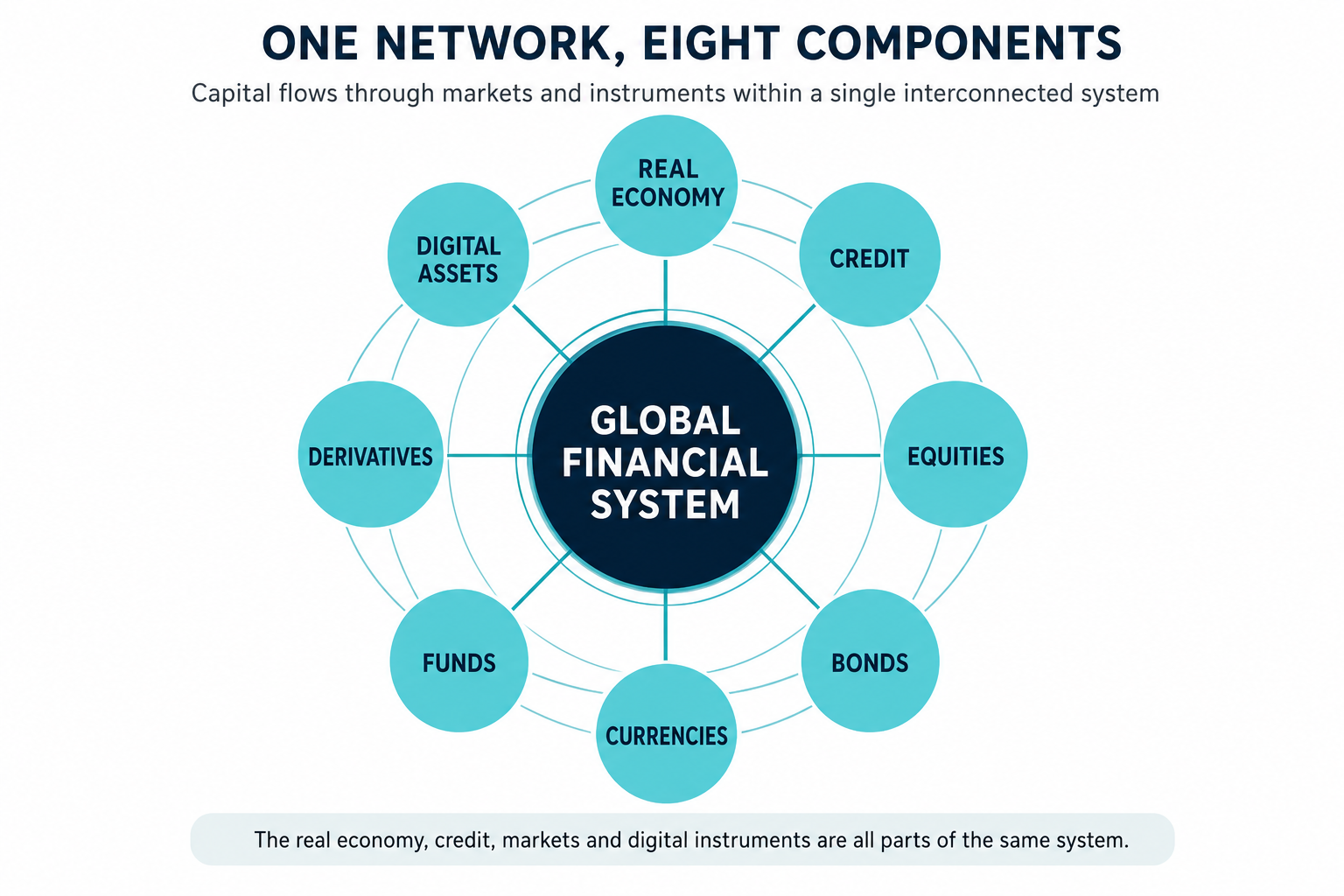
It is a global infrastructure composed of the real economy, debt, equity and bond markets, currencies, funds, derivatives and digital assets.
The first level of the Atlas begins here: measuring the size of the system before analysing its individual components.
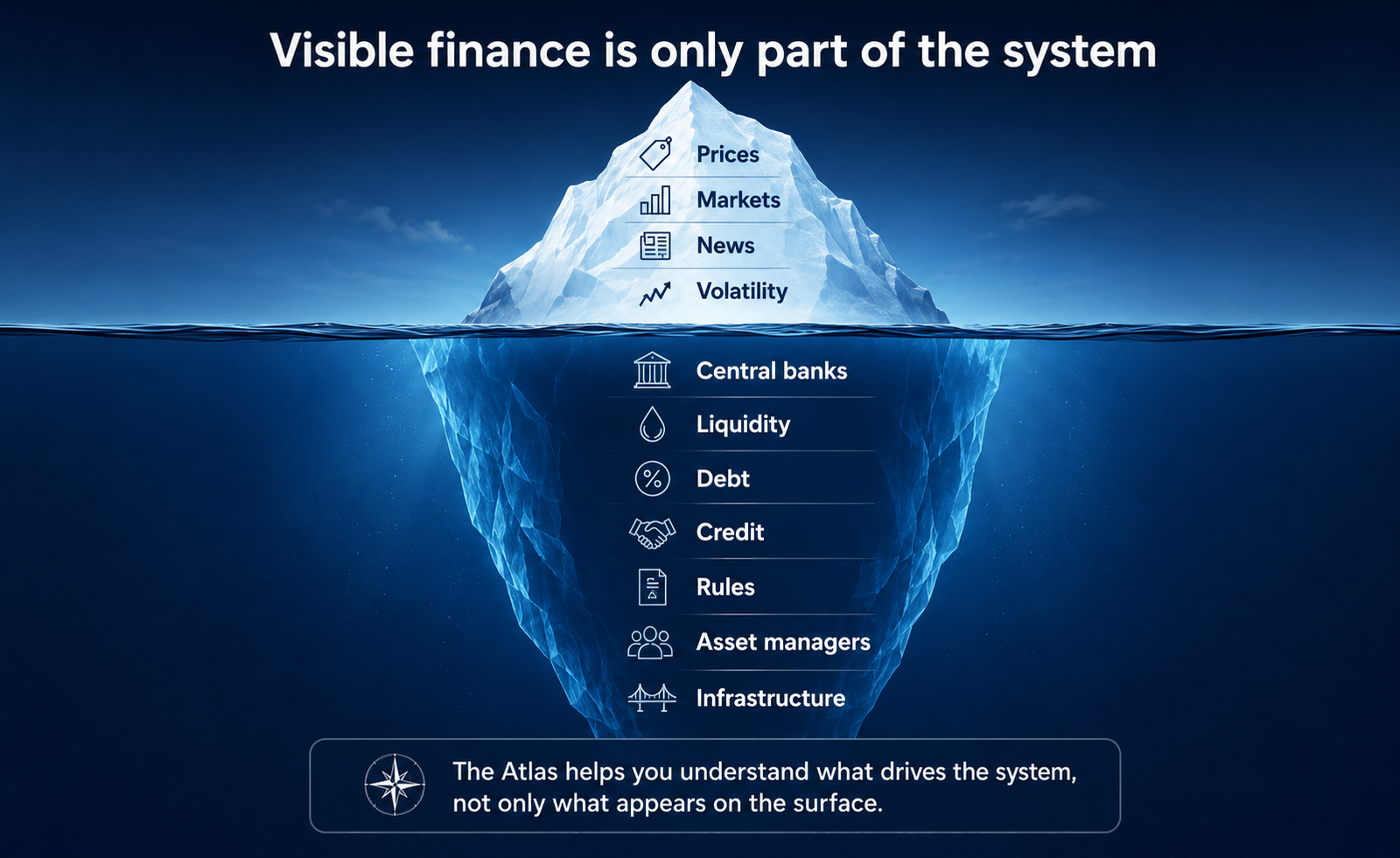
Finance Is Not a Sequence of Events
Daily Coverage Focuses On:
• prices
• indices
• news
• rises and falls
• sudden crises
• central bank decisions
The Real System Consists Of:
• economies and production
• public and private debt
• capital markets
• banks and credit
• currencies and payments
• funds and institutional investors
• derivatives and hedging instruments
• new digital infrastructures
To understand the system, we must view it from above, as we would a map: its size, structure, connections and accessibility.
The Scale of Global Finance
Global finance moves values far greater than the real economy.
Today’s Financial System:
The global financial system exceeds the real economy in scale and connects markets, debt, currencies, funds and derivatives.
This “Scale Gap” Between Finance and the Real Economy Explains:
Volatility, crises and public interventions show how deeply interdependent finance and the real economy have become.
It Is the Invisible Infrastructure That Shapes:
Governments, economic policies, employment, consumption, investment and business growth.
The Architecture of Financial Power
Capital does not move on its own: it is directed by institutions, markets and major asset managers. Understanding who makes the decisions means understanding where financial power resides.
The Core of the System Consists of Specific Actors:
Central banks, commercial banks, capital markets and major asset managers direct liquidity, credit, investment and access to capital.
They Manage Assets Capable of:
Moving markets, influencing currencies, directing credit and changing the cost of capital on a global scale.
Understanding who controls capital and liquidity is essential for interpreting markets, countries and financial instruments.
The Geography of Financial Power
Finance is global, but power remains concentrated in a few hubs capable of directing capital, setting rules and controlling access to markets.
The Atlas reads the planet through key regions:
The United States, Europe, China, Russia, the Middle East, Asia, Africa and Latin America represent different financial balances.
Each one has:
Its own financial structure, strengths, vulnerabilities and a specific role within the global balance.
It is the only serious way to understand:
Who leads, who follows, who depends on whom and who is able to rewrite the rules of the global system.
Why This Map Is Essential
Without a map, noise, emotion and oversimplification replace analysis. The Atlas provides structure, context and a more informed understanding of the global financial
globalfinancialatlas is proudly powered by WordPress