Why This Atlas Exists and How We Read the Financial World
The global financial system is often described superficially:
either as a technical world accessible only to professionals,
or as a casino where someone “wins” and someone “loses”.
Both narratives are wrong.
And dangerous.
This Atlas was created to do something different:
to build a clear, honest and practical map of the financial world.
Not to entertain.
Not to sell products.
Not to fuel illusions.
But to explain how money really moves around the world,
who moves it,
where power is concentrated,
and how these dynamics influence economies, businesses, distribution, franchising and real-world decisions.
We are not here to complicate.
We are here to clarify.
What This Atlas Is — And What It Is Not
This Atlas Is
- a historical and structural reading of the global financial system
- a comparative analysis of regions, countries and financial hubs
- a mapping of actors, powers, instruments and architectures
- a tool for entrepreneurs, decision-makers and serious investors
- a framework for thinking with clarity and prudence, not with euphoria
This Atlas Is Not
- an academic textbook
- an investment guide
- a catalogue of financial products
- a promise of returns
- a collection of “secrets” or shortcuts
We do not tell readers where to invest.
We give them the tools to understand the terrain in which they operate.
Our Principles
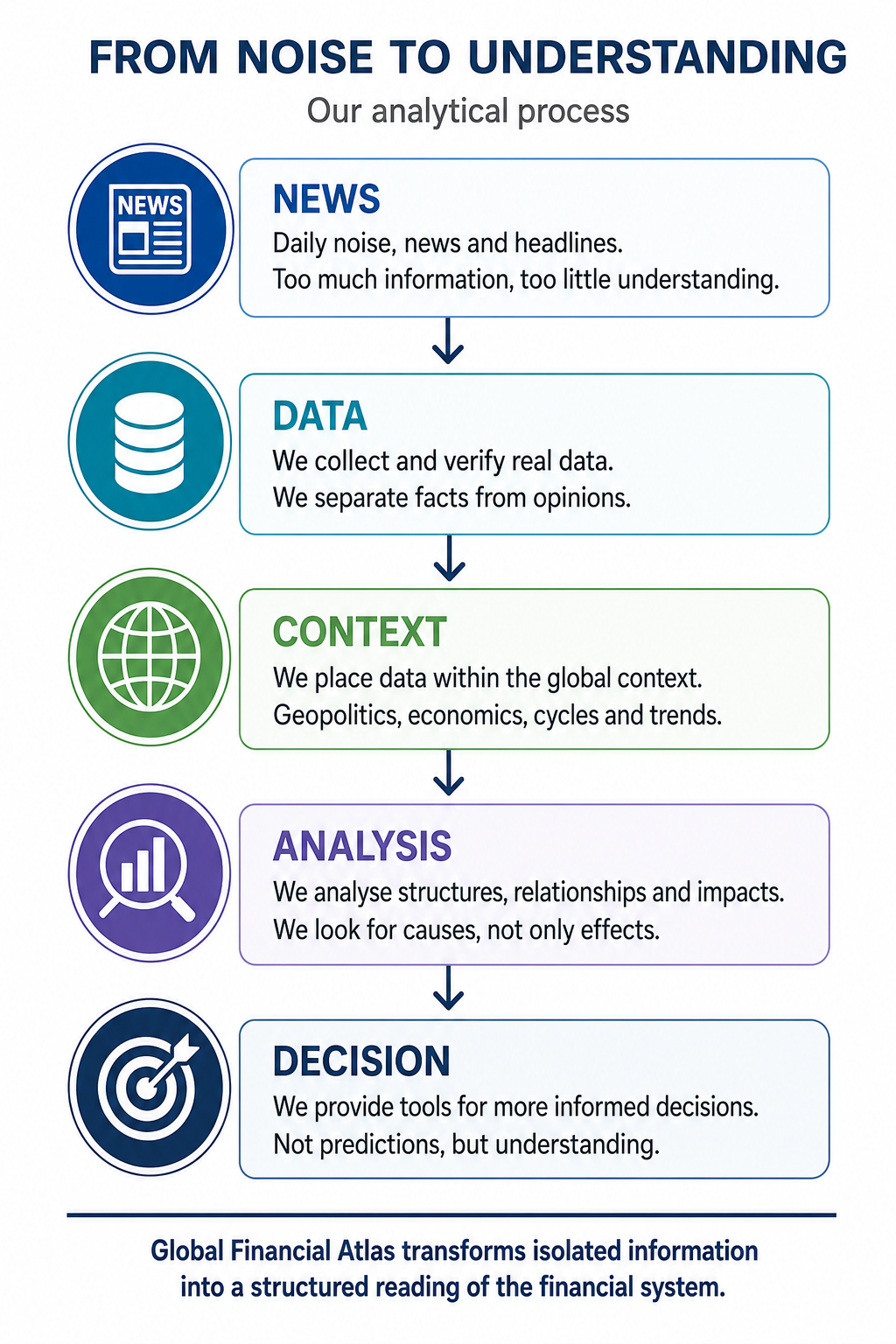
Clarity Over Noise
We eliminate unnecessary jargon.
We cut through narrative excess.
We focus on what truly matters.
Honesty Over Market Narratives
We do not sell financial instruments.
We are not affiliated with any platform.
We have no interest in influencing decisions.
Our only leverage is credibility.
Our responsibility is to our readers.
Depth Over Hype
We prefer an uncomfortable truth to a story that “sells better”.
When the system is fragile, we say so.
When something is overvalued, we say so.
When there is no certainty, we admit it.
Our Method
Our Approach Combines:
- historical perspective
crises, cycles, regime changes and systemic shocks - geographical lens
from the world → to regions → to countries → to individual hubs - structural analysis
actors, powers and constraints - mapping of financial instruments
not individual products, but asset classes and their systemic role - practical implications
for businesses, distribution networks, capital holders, franchising and decision-makers
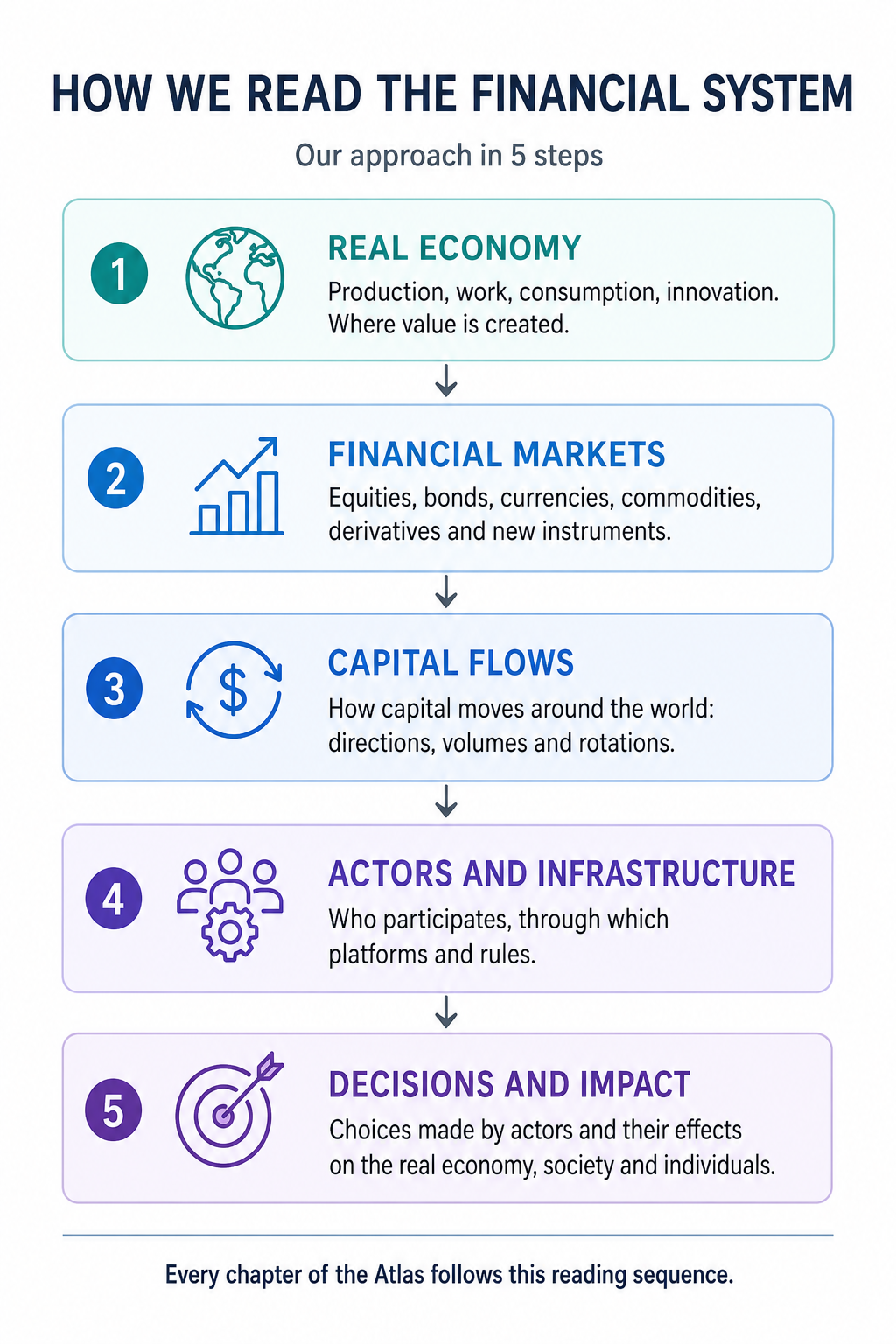
Each Chapter Follows a Disciplined Structure:
- context & history
- key actors & powers
- financial architecture
- strengths & vulnerabilities
- practical implications
Repetition is a method:
it helps us build comparisons, recognise patterns and create a stable mental map.
Scope and Limitations
This Atlas Focuses On:
- the big picture, not market noise
- architecture, not micro-trading
- the relationship between finance, the economy and distribution
We update our analyses only when structural changes occur.
What We Do Not Do
- we do not manage money
- we do not broker investments
- we do not provide personalised financial advice
What We Offer
Context,
language,
understanding,
awareness.
Who This Atlas Is For
This Atlas Is Designed For:
Entrepreneurs
Founders
Retail and Franchising Groups
Professionals
Serious Investors
For Those Who Recognise a Simple Truth:
“I am navigating a financial ocean that I do not truly understand.”
If you are looking for quick formulas to “get rich”, this is not the right place.
If you want to understand how the global financial system really works
and how it affects your business, your clients and your capital,
you are in the right place.
This is the starting point.
From here, the journey into the financial world begins.
globalfinancialatlas is proudly powered by WordPress